Google Ads vs Meta Ads for Shopify Stores: Where Should Your Budget Go in 2026
Every Shopify founder asks the same question eventually: if I had one more pound or one more dollar to spend on ads, where should it go, Google or Meta?
The honest answer is "it depends," but that is not useful on its own. So this post breaks down what the 2026 data shows, what it means for US and UK Shopify brands specifically, and a practical framework for splitting your budget by stage rather than guessing.
Why this question matters more in 2026 than it did a year ago
Two things changed the calculus this year. First, ad costs kept climbing on both platforms. Meta's average CPM rose roughly 20% year over year, and CPA rose even faster, while Google's search auction stayed expensive in competitive ecommerce categories.
Second, attribution kept degrading. Last-click data from either platform increasingly overstates its own contribution, which means brands comparing "Google ROAS" to "Meta ROAS" inside ad dashboards are often comparing two slightly fictional numbers.
None of that means the question is unanswerable. It means you need blended data, not only platform-reported data, and a framework that adjusts with your stage and margins.
Google Ads for Shopify: the case for it
Google Ads, primarily Search and Shopping campaigns for ecommerce, wins on intent. Someone typing "buy waterproof hiking boots size 10" into Google has already decided to buy something. You are competing for the click, not creating the original desire.
That intent shows up directly in the numbers: 2026 benchmark data aggregated across roughly 15,000 advertisers puts average ecommerce ROAS on Google Ads between 4.0x and 8.0x, with a blended average around 4.2x. Google Shopping campaigns specifically tend to outperform Search, often landing in the 5.0x to 6.5x range.
The cost side is steeper, though. Average CPC for ecommerce on Google Ads sits around $1.16, and that is a blended figure. Competitive niches like fashion, supplements, and electronics routinely run higher.
Where Google wins for Shopify brands:
- Catching people who already know what they want
- Shopping ads that show price, image, and reviews directly in search results
- Retargeting search abandoners with strong commercial intent
- Categories with clear, searchable product names
Where it struggles:
- New or unbranded products nobody is searching for yet
- Higher cost per click means thinner margins absorb it less comfortably
- Limited reach if your product needs to be seen before anyone thinks to search for it
Meta Ads for Shopify: the case for it
Meta, Facebook and Instagram, wins on discovery. It does not wait for someone to search. It puts the product in front of someone who did not know they wanted it yet.
That is a different job than Google is built for, and it shows in the numbers: average ecommerce ROAS on Meta in 2026 runs roughly 2.5x to 4.0x, with a blended average closer to 2.8x. That is lower than Google, but Meta is usually doing top-of-funnel work that Google cannot do as cheaply.
Cost per click is meaningfully lower. Average ecommerce CPC on Meta sits around $0.67 to $0.78 in the US, and Meta's average CPM across industries rose to about $14.19 in 2026. Retargeting campaigns on Meta perform disproportionately well, with some benchmark data putting retargeting ROAS as high as 8x.
That gap is the whole game on Meta: prospecting is expensive and unpredictable, retargeting is cheap and reliable, and most of your blended ROAS comes from the mix between the two.
Where Meta wins for Shopify brands:
- Visually strong products such as fashion, beauty, home, food, and lifestyle
- New product launches with no existing search demand
- Retargeting site visitors and cart abandoners cheaply
- Creative testing at scale
Where it struggles:
- Lower intent means more wasted impressions on browsers, not buyers
- Weak creative tanks performance fast
- iOS privacy changes still create attribution gaps, even with Conversions API adoption now around 89% among ecommerce advertisers
Google Ads vs Meta Ads: the head-to-head data
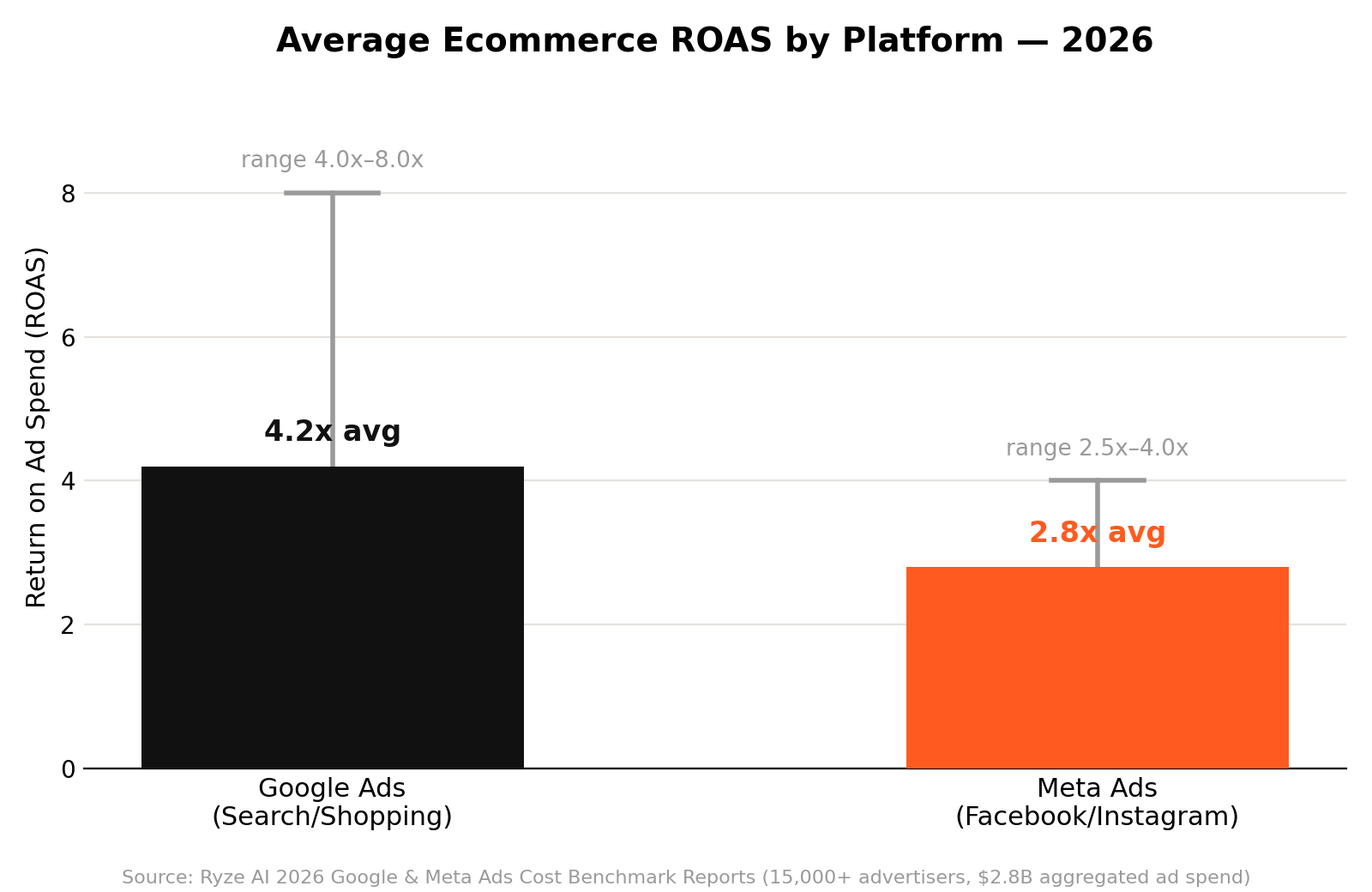
The pattern holds across most categories: Google's intent-driven traffic converts at a higher rate per click, but it costs more to get that click. Meta's traffic converts at a lower rate but costs roughly half as much to acquire, and adds the discovery function Google structurally cannot.
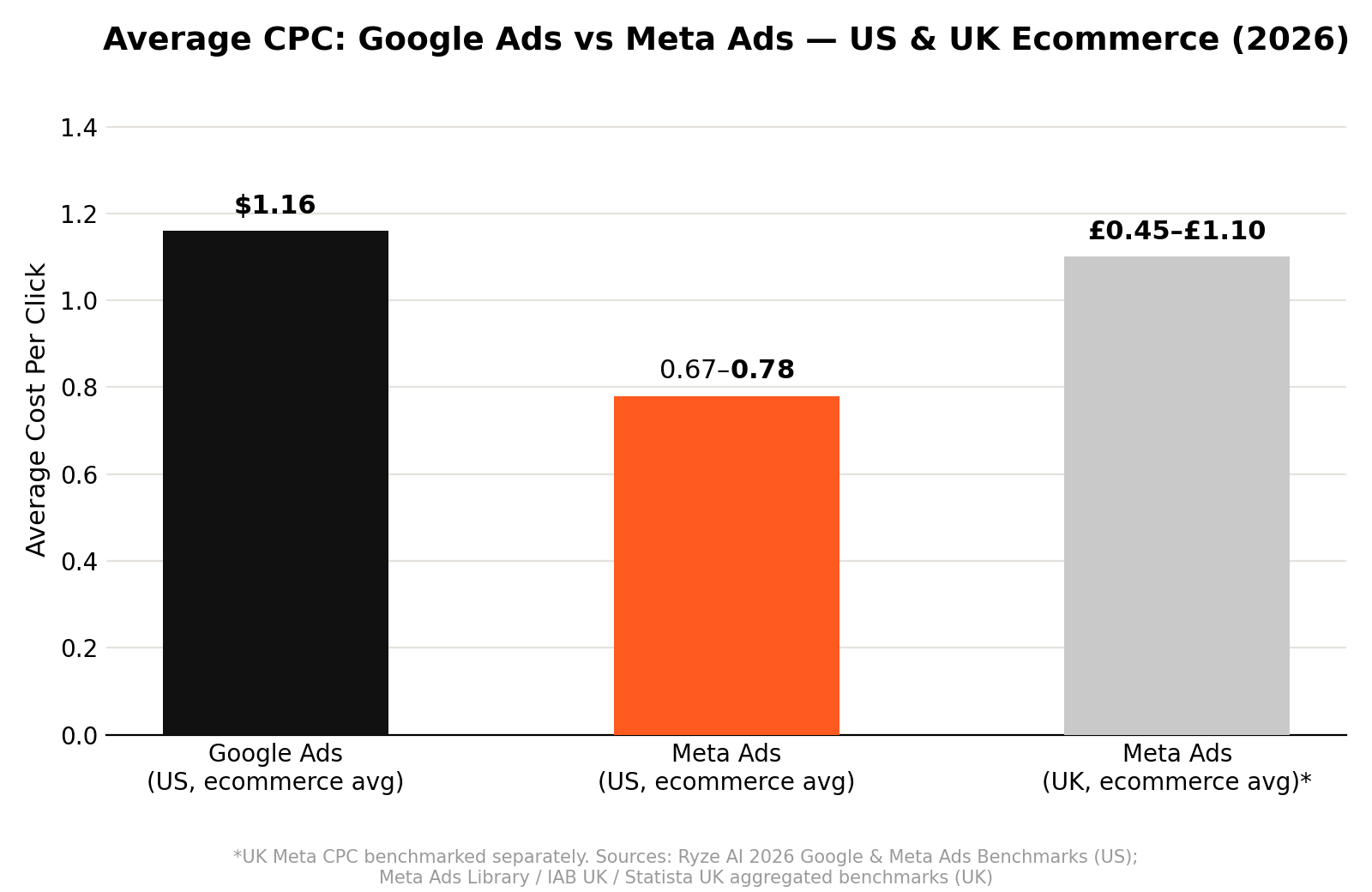
The UK market deserves its own line because most published benchmark reports are US-denominated. UK Meta CPC and CPM benchmarks for ecommerce in 2026 typically run about 15% to 25% above US averages once currency is adjusted, with CPM landing around GBP7.50 to GBP14 for feed placements and CPC in the GBP0.45 to GBP1.10 range depending on vertical and audience temperature.
Q4 adds 35% to 60% to CPMs in both markets, so November and December budget needs to account for that premium rather than absorb it as a surprise.
So which platform should get your budget?
Neither. That is the wrong framing.
The data above is not "pick a winner." It is "match the platform to the job." Google captures demand that already exists. Meta creates demand that does not exist yet.
A Shopify brand that only runs Google will plateau the moment search volume for its category is exhausted. A brand that only runs Meta will keep paying retail-level CAC on cold prospecting forever because it never builds the high-intent search and retargeting pool that makes acquisition cheaper.
The actual lever is how the split shifts as you grow.
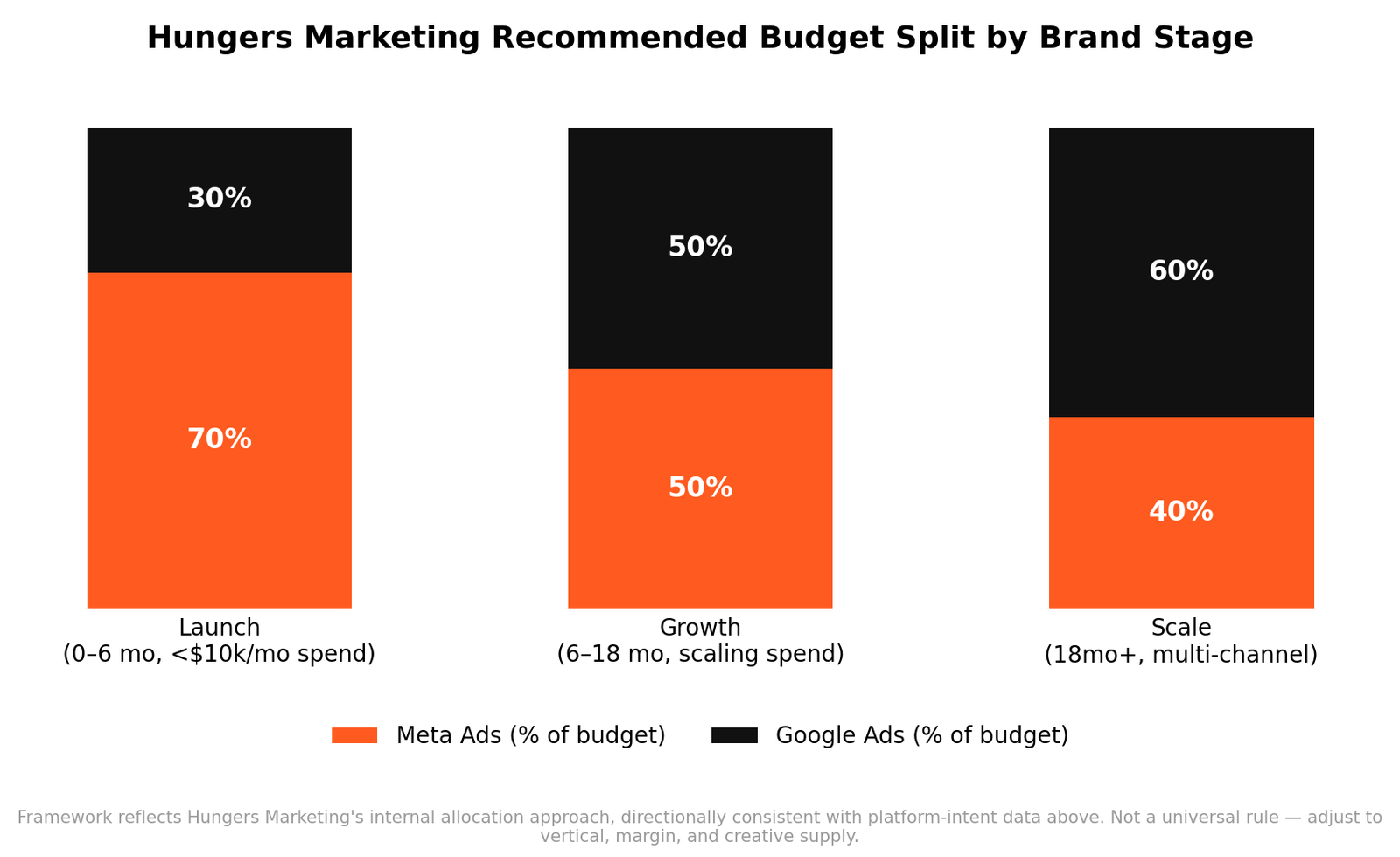
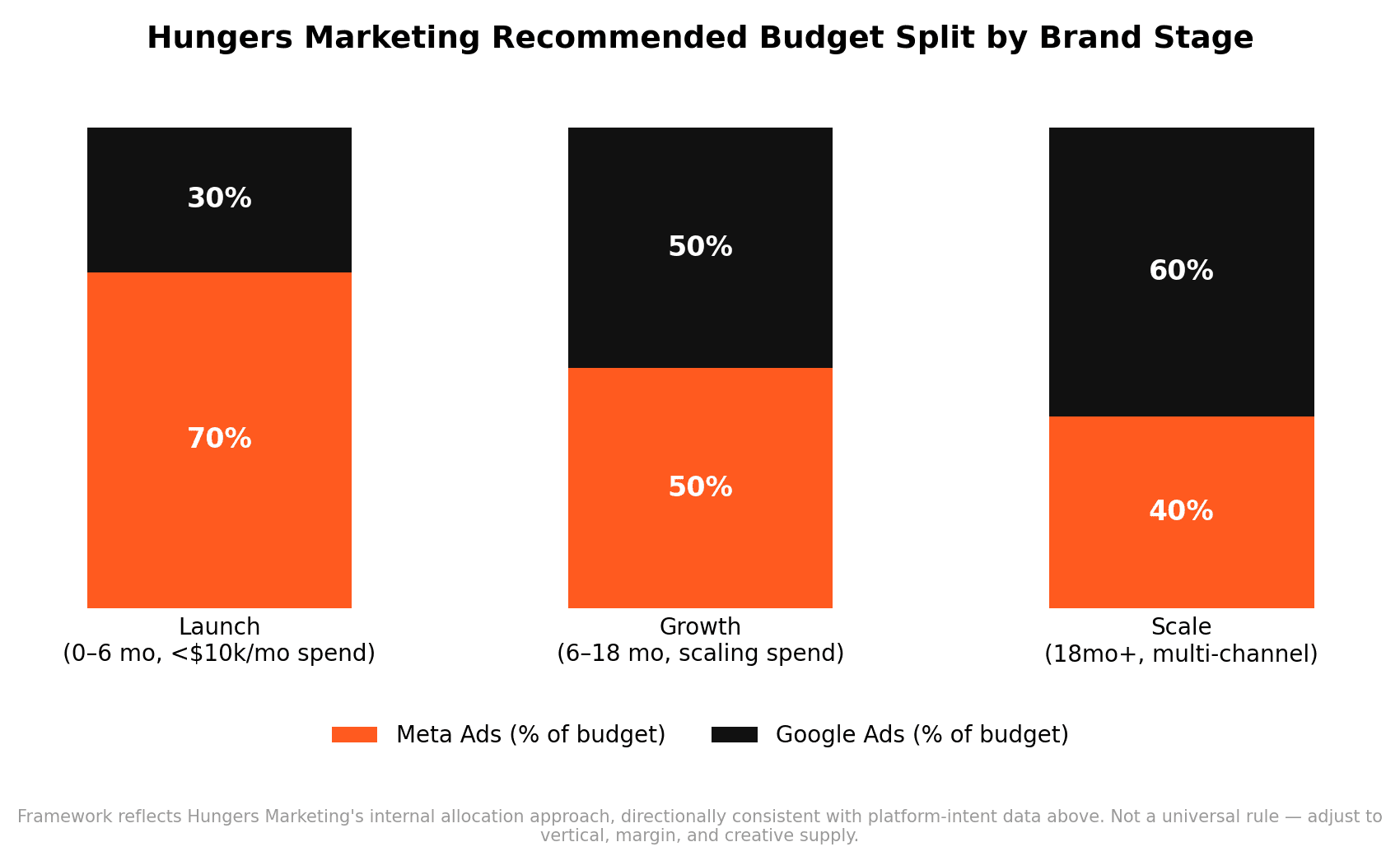
Launch stage: 0 to 6 months
Weight toward Meta. You likely have no branded search volume yet because nobody is googling your product name. Meta builds awareness and starts collecting the retargeting and lookalike audience data that makes everything else cheaper later.
A practical starting split is 70% Meta and 30% Google.
Growth stage: 6 to 18 months
Move toward an even split. Branded search starts appearing as Meta-driven awareness creates people who now search for you by name. That is some of the cheapest traffic you will ever buy, and it is worth defending with Search and Shopping campaigns.
A practical starting split is 50% Meta and 50% Google.
Scale stage: 18+ months
Weight toward Google. At this point your brand has enough recognition that Google captures meaningful demand on its own, your margins can absorb higher CPCs, and Meta increasingly shifts toward a retargeting and retention role rather than carrying the growth load alone.
A practical starting split is 40% Meta and 60% Google.
This is not a universal law. A fashion brand with strong visual creative might keep skewing Meta-heavy even at scale, while a niche tool or supplement brand with strong branded search might flip the ratio earlier. Treat it as a starting point, not a rulebook.
Where to go from here
If you are trying to figure out your own split rather than follow a generic framework, that is exactly what a free audit is for. We look at your actual margins, current channel mix, and creative supply, then tell you where the next pound or dollar should go.
Written by Ali Raza, Director at Hungers Marketing. Ali leads strategy and growth at Hungers Marketing, working with D2C and Shopify brands across the UK and US on performance marketing, Shopify development, and conversion strategy.
Sources: Ryze AI 2026 Google Ads and Meta Ads Cost Benchmark Reports; Meta Ads Library analysis and IAB UK / Statista UK digital advertising benchmarks for UK figures; TrueProfit 2026 ROAS benchmarking analysis; Triple Whale Facebook Ads Benchmarks 2025 dataset. Figures are industry benchmarks, not guarantees. Your results will vary by vertical, margin, and creative quality.